
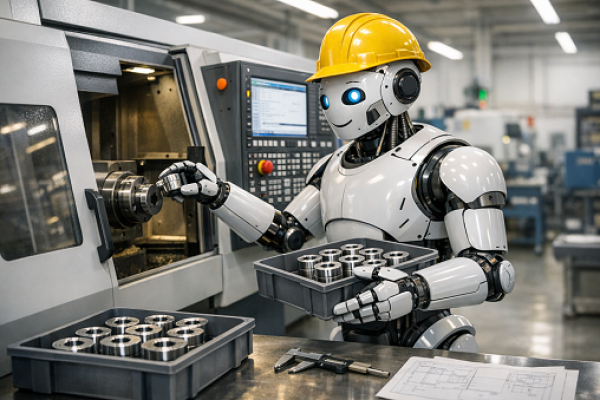
Robotic machine tending has become one of the most practical and widely adopted automation applications across manufacturing. CNCs, presses, molding machines, and test equipment are increasingly supported by robots to extend run time, improve consistency, and reduce dependence on hard‑to‑staff roles.
But while machine tending often looks straightforward on the surface, real-world results vary widely. Some projects deliver fast ROI and become a foundation for future automation. Others struggle with downtime, rework, or operator frustration. The difference is rarely the robot itself—it’s the surrounding details.
Based on what we see across real shop floors, these are the ten factors that most often determine whether robotic machine tending delivers value or becomes a source of friction.
1. The biggest gains usually come from increased machine uptime
Machine tending rarely creates value by making individual cycles faster. The real opportunity is reducing idle time between cycles, breaks, or shifts. When machines wait on operators, capacity is lost regardless of how fast the equipment is capable of running. Well-designed tending focuses on keeping spindles cutting or presses cycling more consistently.
2. Robots support labor reliability—they don’t just replace people
Machine tending is fundamentally about reliability. Repetitive loading and unloading roles are difficult to staff and retain, and variation between operators can introduce inconsistency. Robots stabilize these roles so skilled people can focus on setup, troubleshooting, and quality—work that benefits from human judgment.
3. Process stability matters more than automation itself
Automation amplifies whatever process it is given. If part variation, cycle time drift, or upstream inconsistency already exist, a robot will expose those weaknesses quickly. Successful tending projects usually start by tightening the process first—automation works best when inputs are predictable.
4. Part presentation and fixturing are critical
Robots require consistent, repeatable part presentation. Trays, pallets, drawers, conveyors, or vision systems all serve the same purpose: presenting parts the same way every cycle. Poor presentation leads to mispicks, misloads, fault recovery issues, and scrap—often becoming the dominant reliability problem in early deployments.
5. Machine interfaces and shop environment matter
Reliable communication between the robot and the machine is essential. Cycle start signals, door control, fault handling, and recovery behavior all influence uptime. Physical factors—chip debris, coolant, lighting, temperature, and access for maintenance—also affect long-term reliability more than many teams expect.
6. Safety strategy drives cost, speed, and footprint
Safety is never an afterthought in machine tending. Guarding methods, scanners, interlocks, and collaborative operation decisions directly influence cell size, throughput, and total cost. The right safety strategy balances protection, usability, and access for maintenance without unnecessarily restricting operation.
7. Changeover flexibility often outweighs raw speed
In high-mix environments, the ability to change parts quickly is usually more valuable than shaving seconds off a cycle. Modular fixturing, recipe-based programming, and scalable layouts allow tending cells to adapt as production changes instead of becoming single‑purpose assets.
8. Clear ownership for maintenance and support is essential
Long-term success depends on who owns recovery, adjustments, and upkeep. Robots introduce new components—grippers, sensors, calibration points—that need routine attention. Teams that define ownership early tend to resolve issues faster and maintain confidence in the system.
9. Automation exposes weak spots in the process—often earlier than expected
One understated benefit of machine tending is visibility. Robots run consistently, making small inefficiencies, variation, or handling problems impossible to ignore. While this can initially feel disruptive, it often leads to meaningful process improvement beyond the automation project itself.
10. Machine tending can be a low-risk entry point into robotics—when scalability is planned
When designed with expansion in mind, machine tending is often an accessible first step into robotics. Starting with one machine and planning for future integration allows teams to gain experience, confidence, and internal capability without committing to overly complex automation upfront.
What This Means for Manufacturers
The most successful machine tending projects treat automation as a system—not a standalone robot. By focusing on process stability, presentation, interfaces, and ownership, manufacturers can use tending to increase capacity while reducing operational stress.
If any of these points raise questions about your own operation, we’re always happy to talk them through. Often, the value starts not with equipment—but with asking better questions.