
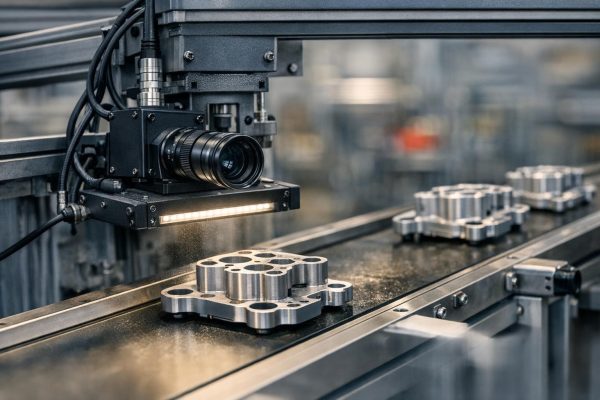
Industrial Machine Vision Systems in Manufacturing: What’s Actually Possible Today?
Industrial machine vision systems have been part of manufacturing for decades. They use cameras, lighting, optics, and software to inspect parts, verify assembly, and make real-time decisions on the production line. What’s changed is what they can actually do and where they make economic sense today. The technology has moved well beyond the tightly controlled camera-in-a-box that many manufacturers evaluated years ago and moved on from. If that’s your last reference point, it’s worth a second look.
This article looks at what’s now practical, what still has real limits, and how to think about whether vision makes sense for a problem you’re trying to solve. The goal is to give an honest picture of the current state.
| The short version: Vision technology has advanced significantly and deployment barriers are lower. The ongoing costs, including data management, retraining, validation after process changes are real and often underestimated. The manufacturers who get the most from vision go in with clear criteria, realistic expectations, and a plan for operating the system over time, not just deploying it. |
Common Applications of Vision Systems in Manufacturing
- Automated inspection and defect detection
- Assembly verification (correct parts, presence, orientation)
- Dimensional measurement and gauging
- Robot guidance and part location
- Process monitoring and SPC feedback
Start Here: Questions Worth Asking Before You Invest
These are the questions that most often determine whether a vision project succeeds or stalls. They’re almost always more valuable to answer before you start than after.
- Is the defect or feature actually visible? Vision can only reveal what light and optics can show. If the answer isn’t clearly yes, the project starts on shaky ground.
- Can you define “acceptable” clearly enough to train a system? Vision enforces a standard consistently—but it cannot define one for you. If your inspectors disagree on what’s acceptable, the system will reflect that disagreement. Getting alignment before a vision project starts saves significant time and rework.
- Do you have—or can you realistically get—representative examples of the variation you need to detect? The quality of your training data drives the quality of your results. This is consistently the hardest part of implementation.
- What happens when the system encounters something it hasn’t seen? There needs to be a clear path for human review of borderline or unexpected cases.
- Who owns ongoing validation and retraining as your process evolves? This is an operating responsibility, not a one-time setup task.
- What are the full ongoing costs, not just setup? Data management, periodic retraining, software licensing, and validation after process changes are real costs that don’t always show up in a vendor’s proposal.
The Old Model and Why It’s No Longer the Only Option
Traditional machine vision systems worked by programming explicit rules: measure this dimension, check this region for brightness, compare this shape to a template. In controlled conditions, they worked well. The problem was fragility. A shift in ambient light, a new material supplier, and a slightly different part orientation could cause false rejects to spike or real defects to slip through. Getting vision right often meant investing heavily in enclosures, fixturing, and lighting control just to make the environment stable enough for the system to work.
That’s still a valid approach for many applications. It is no longer the only approach, and understanding what’s changed opens up applications that weren’t realistic before.
What’s Changed
The advances worth understanding fall into three groups: what you can now inspect, how you deploy and operate a system, and why the business case looks different than it used to.
What you can now inspect
Modern machine vision systems use trained models, not just rules
The most significant shift in vision over the last several years is the move to AI-based inspection. Instead of programming rules, you train the system using representative examples of acceptable and nonconforming parts. Borderline cases are still important. They help define where that boundary sits, but in practice each example is ultimately classified into one category or the other. The resulting model can then distinguish between them in ways that are difficult to define with explicit rules. This is one reason AI-based systems can handle variation more effectively than traditional rule-based approaches.
The practical result is systems that handle variation better and can tackle problems that were previously too hard to define with rules. One important nuance is that AI-based systems fail differently than rule-based ones. A rule-based system usually breaks visibly. An AI model can degrade quietly as production conditions drift beyond what it was trained on. Ongoing monitoring, validation, and periodic retraining are part of operating the system responsibly.
Far less training data than before—but calibrate expectations
Historically, training a vision system required large libraries of labeled defect images. Newer AI approaches can work with significantly fewer examples, lowering the barrier for high-mix environments and applications where defect data is hard to come by.
A word of caution: the right amount of training data depends heavily on defect complexity, surface variability, and tolerance requirements. Some applications work with a small number of examples. Others require substantially more, especially where rare but critical defects need to be caught reliably. Treat vendor claims as a starting point, not a guarantee. There is often a gap between marketing claims and what performs reliably in production. An experienced integrator can help clarify what is realistic.
Difficult surfaces are more solvable, but not for the reason most people assume
Surfaces with natural variation, such as wood grain, metal flake finishes, tool marks, and scratches, have historically been some of the hardest inspection problems because they are difficult to define with rules.
AI-based systems trained on representative examples can better distinguish normal variation from defects in these cases. That said, image quality is still the foundation. If the required information is not captured clearly, no amount of processing or AI can recover it.
Some problems require sensors that capture what standard cameras cannot
For certain problems, the limitation is not the camera itself. The issue is that visible light does not carry the information you need. Examples include detecting a food contaminant that is the same color as the product, verifying material composition, and identifying moisture in a sealed package.
Near-infrared and hyperspectral imaging sensors capture wavelengths that reveal chemical and material properties that standard cameras cannot see. Once limited to labs, these technologies are becoming more practical in production, particularly in food and beverage, pharmaceutical, and battery manufacturing. They are not a replacement for conventional vision. They are a complement for problems where conventional vision reaches its physical limits.
3D sensing is practical, but technology choice matters
3D sensing enables bin picking, assembly verification, and measurement of formed parts in ways 2D imaging cannot. What’s worth knowing before investing: structured light, laser line profilometry, and time-of-flight sensors have meaningfully different performance profiles for speed, resolution, range, and cost. Structured light, for example, can struggle at high line speeds, which is a real constraint in automotive or high-throughput packaging. Choosing the wrong technology is a common and expensive mistake.
How you deploy and operate a vision system
Processing has moved closer to the line
Modern vision systems can run at the inspection point using self-contained hardware, which simplifies deployment for standalone stations or a small number of inspection points. At larger scale, however, a centralized architecture, using multiple networked cameras connected to a single industrial PC often remains the more cost-effective approach. What’s changed is that smart cameras are now powerful enough to handle applications that previously required a full PC, giving manufacturers more flexibility depending on the use case.
Vision is moving upstream into process control
The traditional model was vision at the end of the line: inspect the part, accept or reject. Modern systems can monitor continuously during the process—tracking dimensional trends, surface condition, or positional accuracy and feeding that data back into control systems. The goal shifts from catching defects after the fact to preventing them by detecting drift before it produces bad parts. This is where the strongest ROI cases are being made today.
Uncertain cases can be routed to a person for review
Modern systems flag uncertain cases for human review rather than forcing an automatic accept or reject decision. Inspectors shift from reviewing everything to reviewing what actually needs judgment. It becomes a more effective division of labor between the system and the operator.
Integration with your broader systems has improved
Modern vision systems connect directly to PLC and robot controllers, MES systems, and quality data platforms. This enables real-time process adjustments triggered by vision data, automatic traceability linking results to specific parts and batches, SPC charts populated from vision measurements, and audit trails that document every part through the line. For manufacturers facing customer quality requirements or regulatory traceability obligations, this level of integration is increasingly becoming an expectation.
Why the business case looks different today
The data you collect is a long-term asset
One of the most underappreciated benefits of deploying vision is that you’re building a comprehensive record of what your process actually produces. That includes defect rates by shift, supplier lot, machine, and over time. This data feeds continuous improvement conversations, strengthens supplier accountability discussions with real evidence, and supports warranty analysis.
For leadership thinking about capital allocation, framing vision as infrastructure that generates ongoing data value, not just as an inspection tool, changes the ROI conversation. The value compounds in ways a simple cost-per-reject calculation does not capture.
Plan for the full cost, not just setup
Deployment costs have come down meaningfully. But ongoing costs—data management, periodic retraining, validation testing after process changes, software licensing on AI platforms is real and frequently underestimated. When evaluating a vision investment, ask vendors specifically about the ongoing operational burden. A system that’s inexpensive to deploy but costly to maintain is a different investment than it first appears.
What Actually Determines Whether a Vision System Succeeds
The technology has advanced considerably. The practical factors that determine success haven’t changed as much.
Lighting and image quality
Image quality is still the foundation of any vision system. A well-designed lighting setup can make a hard problem tractable. A poorly designed one can make an easy problem impossible. This is not an area to economize on or treat as an afterthought. It is where expert input at the start often delivers the highest return.
Data quality over data quantity
AI-based systems are only as good as the data they’re trained on. Representative coverage of real-world variation, including edge cases and rare-but-critical defects matters more than volume. This is consistently the most underestimated part of implementation.
Managing the false-reject tradeoff
Every vision system involves a tradeoff between catching defects and generating false rejects. Tighten the threshold and you scrap good parts. Loosen it and you pass bad ones. This tradeoff requires active management and doesn’t go away once the system is running.
Ongoing monitoring and revalidation
Material changes, new suppliers, equipment wear, and environmental shifts can affect performance over time. Periodic validation and retraining is part of operating a vision system responsibly. It should be in the operating budget from day one, not discovered after deployment.
Where Vision Systems Fit and Where They Don’t
Where it tends to perform well
- Assembly and presence verification, including correct parts, correct orientation, correct presence
- Surface defect detection, including scratches, cracks, voids, cosmetic issues
- Dimensional measurement and geometric verification
- Guiding robots and automation, including bin picking, part location, placement verification
- Mid-process monitoring and SPC feedback loops
- Traceability including linking inspection results to parts, batches, and process records
Where it still struggles
- Making judgment calls when the quality standard is ambiguous or subjective
- Handling conditions far outside its training data, even though AI-based systems generally tolerate variation better than rule-based approaches
- Diagnosing root cause or understanding process context beyond what’s in the image
- Replacing the experience and contextual judgment of a skilled operator or engineer
The Bottom Line
Vision technology is more capable, more accessible, and faster to deploy than it was even three or four years ago. The barriers that historically ruled it out, including difficult surfaces, limited training data, high setup cost, and poor integration, are all lower. The manufacturers who succeed with vision aren’t necessarily the ones with the most sophisticated technology. They’re the ones who go in with clear acceptance criteria, realistic expectations about data and ongoing management, and a plan for what happens when conditions change. Done well, vision handles what’s repeatable, which frees your people and your attention for what is not. Often the value starts not with the technology itself, but with asking the right questions first.
If any of these points raise questions about your own operation, or if you are wondering whether a vision system makes sense for a specific application, we are always happy to talk. We work with manufacturers across a range of industries and enjoy helping teams figure out what makes sense before they commit.